
WELCOME HOME
A warm, family-like welcome
Overlooking the Prosecco Hills and nestled in the birthplace of Antonio Canova, Villa Premoli is an elegant residence built in the 17th century. Now reborn following seven years of careful and respectful restoration, it has become a welcoming venue where guests can stay, celebrate their ‘big day’ or organise MICE events and team-building activities.
At Villa Premoli, you will be welcomed by the warmth and discretion of a stately country house, where you can enjoy an oasis of tranquillity and rejuvenating wellbeing.
THE HISTORY
From the 17th century to the present day
Villa Premoli is a 17th-century Venetian villa, situated at the foot of Monte Tomba, just a few minutes from Possagno, the village of the great Antonio Canova, creator of sculptural masterpieces such as the famous statues: Cupid and Psyche, the Three Graces, Paolina Borghese, and many other works of art housed in the nearby Gipsoteca named after him.
The Villa, once owned by the Bianchi family – wool merchants who had been established in the village of Obledo since the 15th century – was passed down through the female line, and thus became, in the second half of the 19th century, the property of the noble Premoli family, from whom Enrico Spagnolo, the current owner along with his wife Paola, is a descendant.
The three-storey main building is surrounded by an Italian-style garden, featuring an ancient Venetian well, the stables and a fine barchessa with a loggia overlooking the Asolo hills. Not to be missed is the charming wine cellar, whose origins are attested by a date carved into the stone, dating it back to 1679.
The oldest part of the present-day villa, with the typical layout of a Venetian house, is divided into three sections: a central hall running the length of the building, flanked by four side rooms.
Opposite the villa lies the traditional ‘brolo’ – that is, the land formerly used for growing fruit, plants and vegetables – which at Villa Premoli is known as ‘cioère’, derived from ‘chiodère’, meaning the place where, in the past, wooden rake-like tools with nail-like ends were used for processing wool.
Today, the orchard has been converted into a vineyard, where Enrico passionately produces an organically certified Prosecco Asolo DOCG, the pride of the estate.

THE RESTORATION
Historical identity and the recognition of continuity
Villa Premoli is a 17th-century Venetian villa, situated at the foot of Monte Tomba, just a few minutes from Possagno, the village of the great Antonio Canova, creator of sculptural masterpieces such as the famous statues: Cupid and Psyche, the Three Graces, Paolina Borghese, and many other works of art housed in the nearby Gipsoteca named after him.
Today, Villa Premoli is a welcoming place thanks to the major conservation restoration work that Paola and Enrico began in 2011 and completed in early 2018.
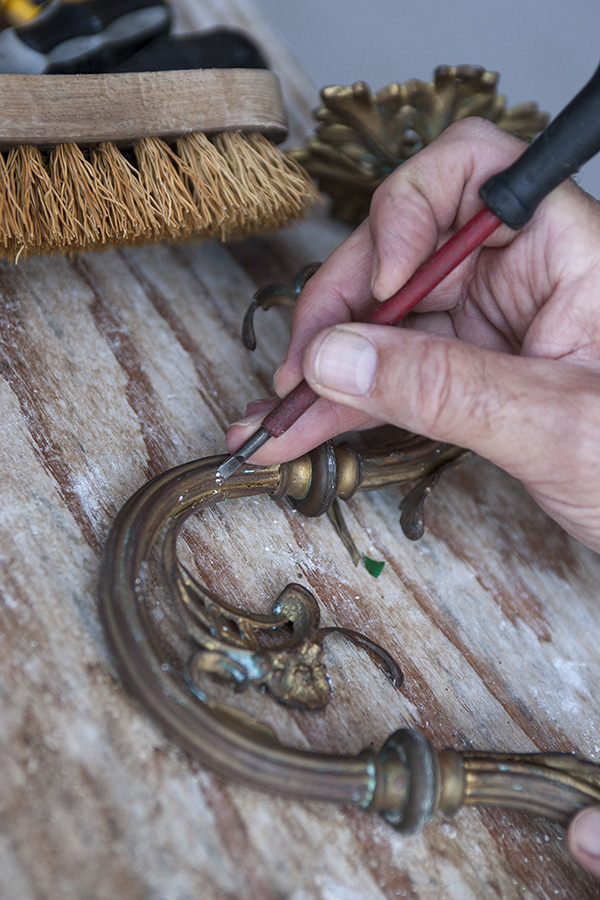
Over the course of these seven years, with great attention to detail and leaving nothing to chance, the Spagnolo family, the architects, and all the professionals and craftsmen involved carried out the work with the utmost care in selecting materials, which, as far as possible, remained those of the past and those native to our region. The shared objective was a restoration aimed at preserving what already existed, bringing it back to life. Every task was carried out with meticulous care by expert craftsmen, who often had to extend the timeframe in order to achieve the best possible result for the benefit of Villa Premoli.
During the restoration, the technical construction skills that distinguish the Venetian architecture of these residences – and which form an integral part of our cultural heritage – came to the fore. All the interior paintings were executed using lime-based materials, as they were originally. Similarly, every element uncovered during the restoration has been highlighted to illustrate the various stages of workmanship that have taken place over the different eras. The Villa is subject to landscape and heritage protection orders issued by the Venice Superintendency of Fine Arts, and this fact serves as a further guarantee – shared by the Spagnolo family – of their commitment to restoring the Villa to its former splendour, whilst never compromising its authenticity.
The preservation of the architectural and artistic features is therefore of paramount importance; during the restoration work, this has been balanced with the introduction of the comforts and facilities necessary for hospitality of the highest standard. Every improvement and every alteration, necessary to transform the property into a tourist accommodation, has been carried out without altering the essence or the original structure of the villa. In particular, the en-suite bathrooms – functional and modern – are added features that can potentially be removed, designed first and foremost to respect the property’s original spaces. Of fundamental importance was the implementation of measures aimed at energy efficiency and environmental sustainability, an issue to which the Spagnolo family has always shown particular sensitivity.
Today, Villa Premoli stands as an example of how the ancient and authentic beauty of our cultural heritage can be perfectly integrated with exclusive, charming hospitality, dedicated to those who know how to appreciate such places.
Over the course of these seven years, with great attention to detail and leaving nothing to chance, the Spagnolo family, the architects, and all the professionals and craftsmen involved carried out the work with the utmost care in selecting materials, which, as far as possible, remained those of the past and those native to our region. The shared objective was a restoration aimed at preserving what already existed, bringing it back to life. Every task was carried out with meticulous care by expert craftsmen, who often had to extend the timeframe in order to achieve the best possible result for the benefit of Villa Premoli.
During the restoration, the technical construction skills that distinguish the Venetian architecture of these residences – and which form an integral part of our cultural heritage – came to the fore. All the interior paintings were executed using lime-based materials, as they were originally. Similarly, every element uncovered during the restoration has been highlighted to illustrate the various stages of workmanship that have taken place over the different eras. The Villa is subject to landscape and heritage protection orders issued by the Venice Superintendency of Fine Arts, and this fact serves as a further guarantee – shared by the Spagnolo family – of their commitment to restoring the Villa to its former splendour, whilst never compromising its authenticity.
The preservation of the architectural and artistic features is therefore of paramount importance; during the restoration work, this has been balanced with the introduction of the comforts and facilities necessary for hospitality of the highest standard. Every improvement and every alteration, necessary to transform the property into a tourist accommodation, has been carried out without altering the essence or the original structure of the villa. In particular, the en-suite bathrooms – functional and modern – are added features that can potentially be removed, designed first and foremost to respect the property’s original spaces. Of fundamental importance was the implementation of measures aimed at energy efficiency and environmental sustainability, an issue to which the Spagnolo family has always shown particular sensitivity.
Today, Villa Premoli stands as an example of how the ancient and authentic beauty of our cultural heritage can be perfectly integrated with exclusive, charming hospitality, dedicated to those who know how to appreciate such places.